
Ordering formwork plywood sounds simple until the pour date is close and the numbers start wobbling. Too little and the crew is patching with offcuts. Too much and there is a sad stack sitting in the yard, slowly copping rain.
This guide keeps it practical and Australian based. It is not a structural sign off. It is a clean way to estimate quantities, then add the right waste and reuse assumptions so they can order with confidence.
How is formwork plywood usually measured on Australian sites?
Most suppliers quote by sheet size and thickness, then sometimes by “face area” in square metres. In Australia, a common sheet is 2400 x 1200 mm, which is 2.88 m² per sheet, though 1800 x 1200 mm also turns up.
So the basic logic is always area first. Total form face area, divided by sheet area, then adjusted for waste, joints, and reuse.
What information do they need before estimating formwork plywood?
They need the form face areas and the form type, not just the slab size. At minimum, they should gather slab edges, beam sides, pier faces, column perimeters, and any rebates or step downs.
They also need the deck method. A suspended slab deck eats sheets differently to edge boxing. Same with wall forms, where ties and studs dictate panel sizes.
How do they calculate slab deck sheets using formwork plywood?
They calculate the soffit area, then convert to sheets. For example, a 10 m x 12 m suspended slab has 120 m² soffit area. Divide by 2.88 m² per sheet to get 41.7, so 42 sheets before waste.
Then add allowances for cut ins around penetrations, columns, stair voids, and odd spans. With formwork plywood, it is rarely a neat grid in real life.
How do they estimate edge formwork and boxing with formwork plywood?
They estimate the vertical face area around the slab perimeter and any internal thickenings. If the slab is 10 m x 12 m, the perimeter is 44 m. If the edge is 300 mm deep, the face area is 44 x 0.3 = 13.2 m².
That is about 4.6 sheets, so 5 sheets, then add corners and bracing cut-offs. Edge work burns scraps fast, especially when using formwork plywood for returns.
How do they work out wall form quantities for formwork plywood?
They take wall length x wall height x 2 faces, then subtract large openings if they will be formed separately. A 6 m long wall at 2.7 m high is 16.2 m² per face, 32.4 m² both sides.
32.4 divided by 2.88 is 11.25 sheets, so 12 sheets, before waste. With formwork plywood, walls often need more trimming because panel joins must land on studs or walers.
How do they estimate columns and piers using formwork plywood?
They calculate perimeter x height for each column, then add them up. A 400 x 400 mm column has a 1.6 m perimeter. At 3 m height, that is 4.8 m² per column.
That is 1.67 sheets, but columns are usually cut from larger sheets and generate offcuts. If there are many columns, offcuts can be reused. If there are only one or two, formwork plywood waste can be ugly.
What waste factor should they add for formwork plywood?
For first pass estimating, 10 per cent is a solid starting point for simple decks and straight walls. If there are lots of penetrations, curves, stairs, or tight architectural edges, 15 to 20 per cent is more realistic.
Waste is not only offcuts. It is also damaged sheets, swelling from weather, and faces ruined by poor release agent habits. With formwork plywood, site storage matters more than people admit.
How much does re use reduce the total formwork plywood order?
If they are buying for multiple pours, re use is where the savings live. Good quality sealed or film faced sheets might get 10 to 30 re uses on well managed commercial sites, but smaller jobs may only get a few.
For a single residential suspended slab in Sydney or Brisbane, they should assume low re use unless the builder is disciplined. Re use affects whether they hire, buy, or mix both for formwork plywood.
Should they calculate in square metres or by sheet count for formwork plywood?
They should do both, then sanity check. Square metres is great for totals and comparisons. Sheet count is what gets ordered, delivered, and counted in the rain at 6.30 am.
A quick check helps too. If the deck area is 120 m² and they are ordering 70 sheets, something is off unless there is major cutting or staging. formwork plywood estimates should feel plausible.
What about joints, stud spacing, and panel layout with formwork plywood?
They should remember that not every square metre is “coverable” without creating skinny strips. If studs or joists are set out to 450 or 600 centres, some layouts will force extra joins and extra sheets.
The best practice is a rough panel layout, even a sketch. One hour of layout can save a surprising amount of formwork plywood and time on the tools.
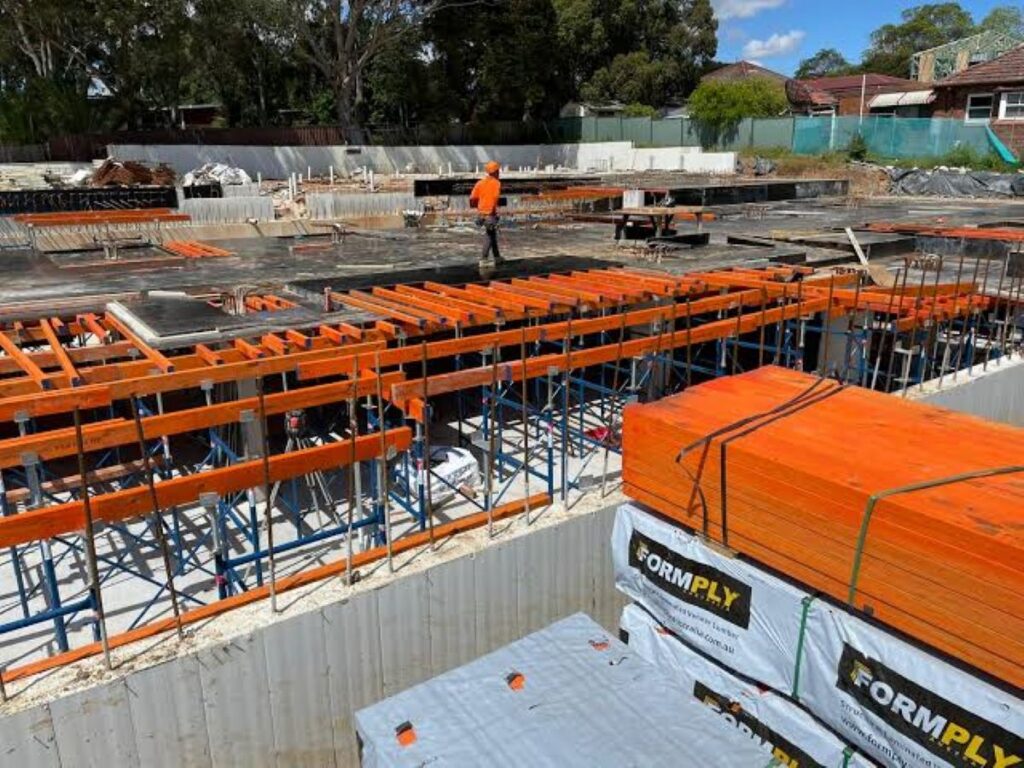
How do they handle stair voids, penetrations, and set downs with formwork plywood?
They should add them back in as complexity, not just subtract area. Yes, a big void reduces soffit area. But it adds trimming, framing, edge forms, and often awkward little panels that cannot be reused.
For services penetrations, the area is tiny but the labour and offcut waste is not. On jobs with many sleeves, formwork plywood usage usually creeps up.
Do they need different thicknesses of formwork plywood for different elements?
Yes, sometimes, and it changes quantities. Thicker sheets may span further and reduce secondary framing, but they cost more per sheet and are heavier to handle.
In Australia, decks and walls commonly use 17 mm film faced, but designs vary. They should follow engineer and formwork supplier guidance. The estimate should split by thickness if the job needs more than one type of formwork plywood. Check out more guidence on formwork.
When is it better to hire panels instead of buying formwork plywood?
If it is a one-off pour or a tight site with nowhere to store and keep sheets dry, hiring can be the cleaner call. Many Australian formwork suppliers offer modular systems that reduce cutting and waste.
Buying suits builders who can store sheets properly and reuse them across projects. Either way, the estimate still matters. Overordering hired formwork plywood is just as painful; it just shows up on the invoice faster.
What is a quick example estimate they can copy for formwork plywood?
They can run a simple four-line estimate, then add waste.
Example: a small suspended slab in Melbourne. Deck 9 m x 11 m = 99 m². Sheets: 99 / 2.88 = 34.4, round to 35. Add 10 per cent waste = 39 sheets.
Edges: perimeter 40 m, depth 0.3 m, area 12 m². Sheets: 12 / 2.88 = 4.2, round to 5. Add a couple for corners and offcuts, call it 7.
Total order: about 46 sheets, then adjust if there are voids, beams, drop panels, or staged pours. That is a reasonable starting point for formwork plywood planning.
How do they avoid the most common ordering mistakes with formwork plywood?
They should avoid assuming slab area equals sheet count, and they should stop ignoring edges and complexity. The fastest way to blow the estimate is forgetting vertical faces, set downs, or wall returns.
They should also avoid ordering before confirming pour staging. If the job is poured in two stages, they might not need the full deck quantity at once. With formwork plywood, timing affects both cost and chaos.
What is the simplest rule of thumb for formwork plywood?
They should calculate form face area, divide by 2.88 m² per standard sheet, then add 10 to 20 per cent for waste depending on complexity. Then they should do a quick layout check to catch skinny strips and awkward joins.
It is not glamorous, but it works. And it usually lands them close enough that the crew is not begging for one more sheet on pour morning, which is the real goal with formwork plywood.
Related : Formply Grades and Sizes Explained
FAQs (Frequently Asked Questions)
How is formwork plywood typically measured on Australian construction sites?
In Australia, formwork plywood is usually measured by sheet size and thickness, often quoted by suppliers in terms of face area in square metres. A common sheet size is 2400 x 1200 mm, equating to 2.88 m² per sheet, though 1800 x 1200 mm sheets are also used. The basic calculation involves determining the total form face area, dividing it by the sheet area, and then adjusting for waste, joints, and reuse factors.
What key information is needed before estimating quantities of formwork plywood?
Before estimating formwork plywood requirements, it’s essential to gather detailed form face areas and understand the form types involved—not just slab sizes. This includes slab edges, beam sides, pier faces, column perimeters, rebates or step downs, and the deck method used. Different deck methods like suspended slabs versus edge boxing affect plywood consumption differently. For walls, ties and studs influence panel sizes and quantities.
How do you calculate the number of sheets needed for slab decks using formwork plywood?
To calculate slab deck sheets, first determine the soffit area (e.g., a 10 m x 12 m suspended slab equals 120 m²). Divide this area by the sheet size (2.88 m² for a standard sheet) to find the base number of sheets (41.7 sheets rounds to 42). Then add allowances for cut-ins around penetrations, columns, stair voids, and irregular spans since real-life layouts rarely conform to neat grids.
What waste factor should be applied when ordering formwork plywood?
A waste factor of about 10% is a solid starting point for simple decks and straight walls during initial estimates. For projects with numerous penetrations, curves, stairs or complex architectural features, increasing this factor to between 15% and 20% is more realistic. Waste includes offcuts, damaged sheets, weather-related swelling and ruined faces due to poor release agent application. Proper site storage also plays a crucial role in minimising waste.
How does reusing formwork plywood affect total order quantities?
Reusing formwork plywood can significantly reduce total orders if purchasing for multiple pours. High-quality sealed or film-faced sheets may be reused 10 to 30 times on well-managed commercial sites. However, smaller residential jobs might only achieve a few reuses unless managed carefully. Reuse considerations influence whether to hire or buy plywood or use a combination of both.
Should estimations be calculated in square metres or sheet count for ordering formwork plywood?
It’s best practice to calculate both square metres and sheet count when estimating formwork plywood needs. Square metres help with overall totals and comparisons while sheet count corresponds directly with ordering and delivery quantities. Conducting sanity checks ensures estimates are plausible; for example, ordering an excessively high number of sheets relative to deck area indicates miscalculations or overlooked cutting/staging complexities.
Related Posts

Formply vs Standard Plywood: What Construction Teams Need to Know
This guide breaks down the practical differences teams need to…
Formply Grades and Sizes Explained
To keep it simple, it sticks to Australian supply, Australian…
Comparing LVL Formwork vs. Traditional Timber: Pros and Cons
The construction industry offers a range of options when it…